Effective implementation of a digital strategy: a case study of the launch of local PEPCO websites in 18 markets
BUSINESS CHALLENGE
Loss of local traffic in search results
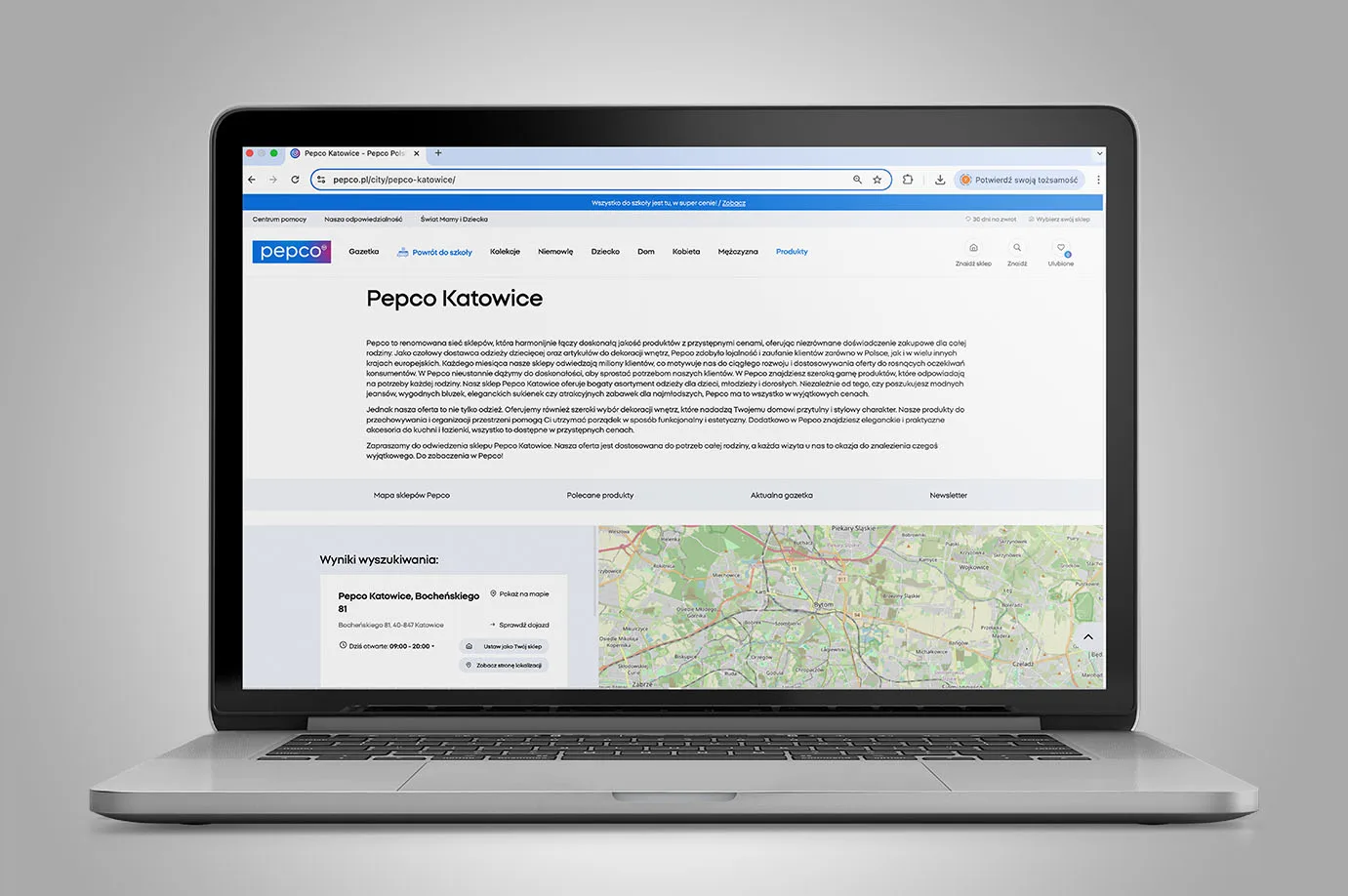
Today’s consumers search for information locally: they type phrases such as “PEPCO Kraków” or “PEPCO Warszawa” into Google. Until now, however, such queries have mainly directed traffic to external websites aggregating flyers and information about stores. For the PEPCO brand, this meant a loss of control over this traffic and limited contact with potential customers at the local level. From a digital and SEO strategy perspective, this was a serious problem. It was necessary to regain visibility and organic traffic, as well as to create a tool that would allow the brand to scale its local presence across multiple markets.
PROJECT OBJECTIVE
Capturing local queries and building brand visibility on Google
The goal of the project was to design and implement a scalable system of local pages for PEPCO stores in every market where the brand operates. The pages were to respond precisely to local user intentions, taking into account both queries such as “PEPCO + city” and “PEPCO + specific store address.” It was crucial to provide valuable, unique content integrated with a central management system, but with the option of local personalization. The project also assumed consistency with the brand image, easy scaling to new markets, and maximization of SEO effects: regaining organic traffic, increasing the number of clicks, and improving search engine rankings. This allowed PEPCO to regain control over its own traffic, strengthen its presence on Google, and have a real impact on the user experience at the local level.
STRATEGIC APPROACH
Localization + central management = scalability
Our key project assumption was to combine a central management model with a local approach to content and SEO. A flexible framework was created, allowing us to create pages for specific stores (e.g., PEPCO Wrocław, PEPCO Berlin, PEPCO Madrid), while maintaining a consistent layout and logic, but with the possibility of local editing of content, newsletters, contact details, and blog posts. The website creation process focused on two main categories of user queries: brand + city (e.g., “PEPCO Gdańsk”) and brand + specific store address (e.g., “PEPCO Warszawa, ul. Garażowa 8A”). This made it possible to respond precisely to local search intentions and maximize visibility on Google. We used mechanisms to automate content generation based on location data, but with linguistic and editorial control to ensure quality and uniqueness. We developed the project in stages: first in Poland, and then gradually implemented it in other markets.
IMPLEMENTATION IN PRACTICE
From Poland to 18 European markets
The project began with a pilot program in Poland, where SEO structures were implemented and over 1,300 URL addresses and local content were created. We performed technical optimization on these addresses. Then, thanks to a scalable model, we expanded our project to 17 other European markets, including the Czech Republic, Romania, Hungary, Spain, Estonia, and Germany. The implementations were carried out in accordance with local language and formal requirements, in close cooperation with local marketing teams. Each page was indexed and optimized for local phrases. An important element was maintaining high mobility and speed of the pages. The standardized process allowed us to maintain high quality at a rapid pace of expansion.
CONTENT & SEO
Structure, content, and linking as the foundations of visibility
The main pillars of SEO effectiveness were: a well-thought-out information structure (subpage architecture of stores), unique content describing the location, offer, and news, as well as strong internal linking. Each store page was optimized for specific local queries, which enabled high rankings for phrases such as “PEPCO + city.” Some of the on-site elements that were taken care of were: titles, headers, meta tags, structured data, and mobile versions. Technical optimization was also a key aspect: crawl budget, sitemaps, hreflangs, page loading speed. All of this supported the long-term building of domain authority in the eyes of Google.
RESULTS
500,000 organic clicks in 6 months
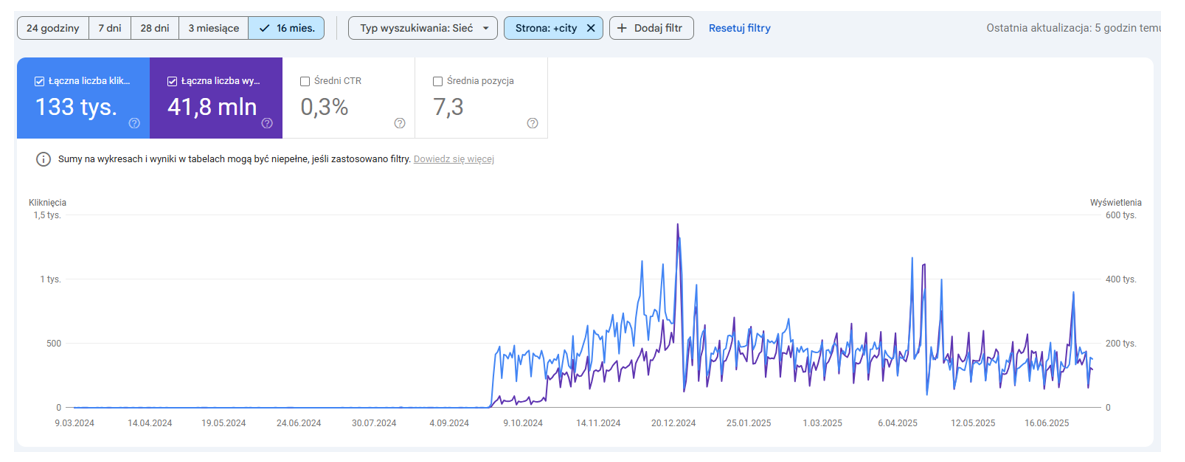
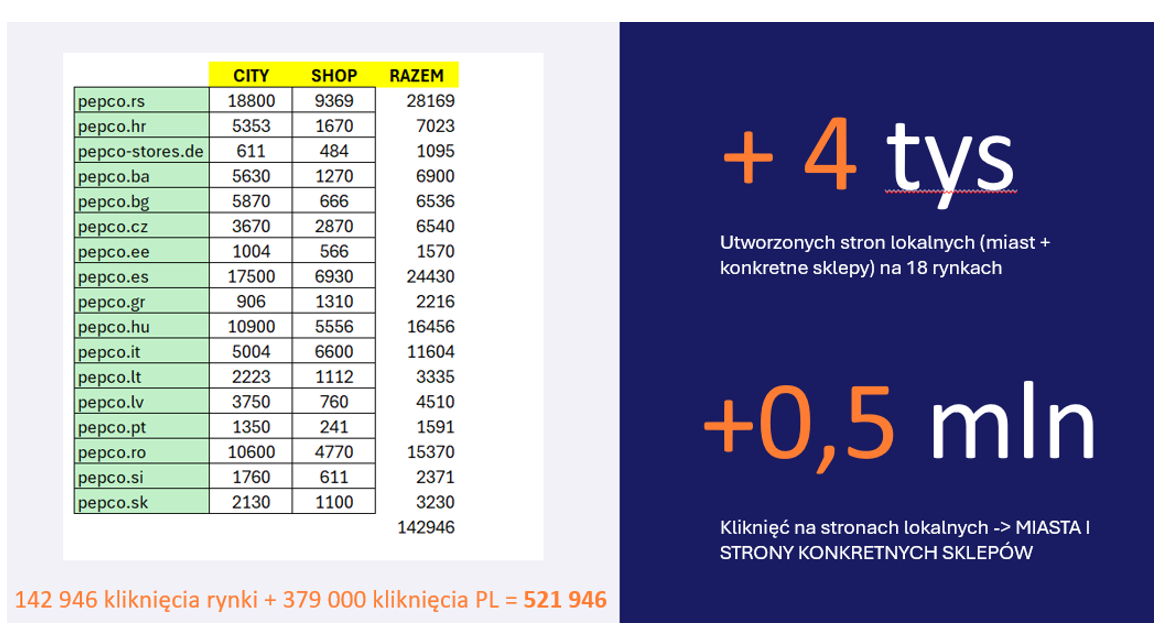
In the first 6 months after implementation, the new pages generated a total of over 500,000 organic clicks from Google search. A significant part of this traffic consisted of local queries, previously captured by external portals. Not only did the number of visits increase, but so did the average time spent on the site and user engagement. In addition, key technical indicators improved, which had a positive impact on the crawl rate and indexing of new pages. The project showed that a well-planned and executed SEO strategy can have a measurable impact on business goals.
City pages – POLAND
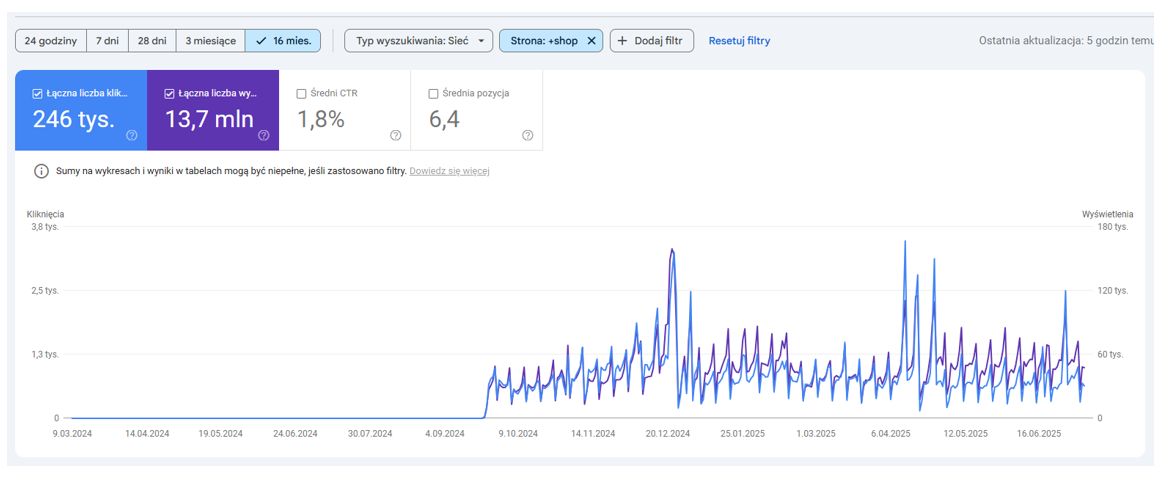
Pages for specific store locations – POLAND
PROJECT TEAM
competencies and cooperation
The success of the implementation was possible thanks to the work of a well-coordinated team of specialists at our agency. The SEO Project Manager was responsible for coordinating all activities and maintaining ongoing contact with the client, ensuring timeliness, consistency of implementation, and translating business goals into operational activities. The SEO specialist was responsible for audits, keyword analysis, technical recommendations, and the implementation of visibility optimization strategies. The team also included a UX specialist who ensured intuitive navigation and user experience on each local version of the website. The whole process was supported by a web developer and administrator responsible for implementing changes, managing the CMS, and technical optimization of the websites.
Results of the local website project -> organic traffic in 18 markets increased by 0.5 million
CONCLUSIONS AND RECOMMENDATIONS
What can inspire other brands?
The case of PEPCO and local websites is an example of the effective implementation of a distributed digital strategy while maintaining brand consistency. It shows that it is possible to regain local traffic by combining automation with content personalization and central management. Implementation in 18 markets confirms that scalability does not have to mean compromising on quality. The client has gained a real benefit – every user entering a local query is directed to the brand’s website, where they can find not only store details (address, opening hours), but also recommended products and related blog articles. This translates not only into increased traffic and better conversion, but also into customer satisfaction with full control over communication and user experience.
The success of our local website project offers valuable insights for retail brands looking to manage their SEO visibility effectively, all while maintaining operational agility. It demonstrates that a thoughtfully designed digital presence can not only enhance marketing efforts but also contribute directly to achieving business goals.
SEO Project Manager, Paweł Kondrat